
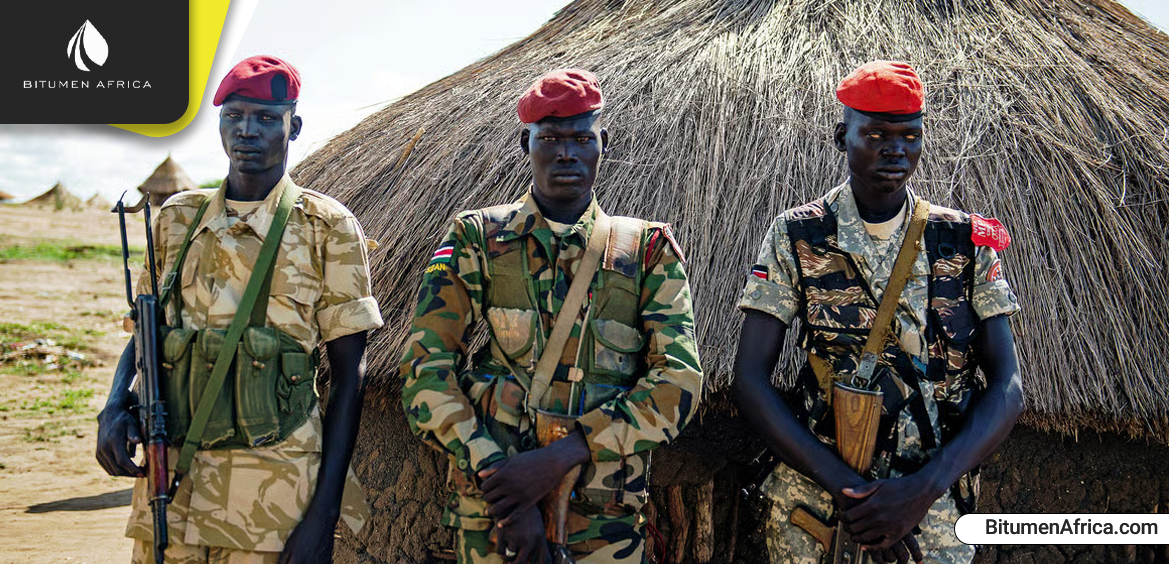
As Sudan’s civil war intensifies, South Sudan has taken an unprecedented step to safeguard its lifeline: the Heglig oil field. In a rare arrangement, South Sudanese troops have entered the facility under what officials describe as a tripartite agreement with Sudan’s two warring factions—the Sudanese Armed Forces (SAF) and the Rapid Support Forces (RSF).
🛡️ A Neutral Deployment
South Sudan’s army chief of staff, Paul Nang, announced from Heglig that the deployment was agreed upon by:
- President Salva Kiir of South Sudan
- Abdelfattah El Burhan, leader of the SAF
- Mohamed Hamdan Dagalo, commander of the RSF
Under the deal, both Sudanese factions are to withdraw from the area, leaving South Sudanese forces to secure vital oil infrastructure. Nang stressed that the mission is strictly defensive: troops will not participate in combat but will work to “completely neutralise” the oil field as a battleground.
⛽ Why Heglig Matters
For Juba, Heglig is indispensable. The field hosts a central processing facility capable of handling 130,000 barrels per day of South Sudanese crude, exported via pipelines through Sudan to Port Sudan. After nearly a year-long suspension, South Sudan resumed oil exports in January, making stability at Heglig critical to its fragile economy.
By contrast, Sudanese economists argue that Heglig’s loss has limited impact on Khartoum’s finances. But for South Sudan, any disruption could be devastating.
📉 Production Challenges
The conflict has already taken a toll:
- Output has plunged from 65,000 barrels per day to just 20,000 since fighting erupted in April 2023.
- The situation worsened when China National Petroleum Corporation (CNPC) announced its withdrawal from Sudan after three decades, citing deteriorating security in West Kordofan.
This exit underscores the growing risks for international investors and the precarious future of Sudan’s oil sector.
🌍 Regional and Global Implications
South Sudan’s intervention highlights the interconnected nature of energy security in the region:
- It reflects Juba’s dependence on Sudanese pipelines for exports.
- It signals how fragile oil infrastructure can become a bargaining chip—or casualty—in wider conflicts.
- It raises questions about whether similar neutral arrangements could be replicated elsewhere to shield critical assets from war.